Old School Radical. v1.0 - 05/26
You're a skater in the realm of Orrelia. Elf, goblin, dwarf, orc, halfling, whatever. You've got your board
and you know the sickest spots.
It's The Warden's Run Long Weekend for the city of Glimmerhold, most of the citizens have cleared out for
3 days while everyone
watches the race in the eastern grasslands.
You got your hands on a Reveal Wide Mind spell scroll, which allows you to record and create
memories of your skate tricks! This is the perfect time to hit the busier spots in Glimmerhold and capture
tricks for a skate "video". You have 3 days to land the best tricks you can before the city returns to its
overcrowded self.
You're not trying to win, they're trying to get the raddest clips before the city shuts you down.
To play OSRad you'll need four to six d6 for skating, two d6 to track daylight and kickout, three plus player count d6 for the spot, the printables pdf printed, some pencils, ideally a d8 and a d20 and the rulebook.
Skateboarding knowledge will definitely help get into the vibe but is not at all needed to play.
Pick a name and roll a species. Then assign 4 points across your three stats. Each stat starts at 1 and no stat may exceed 3.
After roll Stance, Style and Steez.
Each skater has 3 GNAR. These are effectively your hit points. When GNAR is 0 you're too beat up to skate. GNAR refreshes at the start of the next day.
Each skater has 2 Rerolls per trick attempt. After your first reroll, if you have no 4, you may set one die to 4. Refreshes before each trick attempt.
All folks skate, some skate different.
| d6 | Species | Bonus |
|---|---|---|
| 1 | Goblin | Small Frame: GNAR 2, may ignore Slam damage once per day. Gnarly spots deal 1 GNAR not 2. |
| 2 | Dwarf | Stoneskin: GNAR 4. FLIP max 2. Cannot take more than 1 damage from a Slam. |
| 3 | Elf | Elven Grace: FLIP max 4. Technical features cost one less to attempt. |
| 4 | Orc | Tenacity: Once per day, when your GNAR hits 0, set it to 1 instead. |
| 5 | Halfling | Lucky: Once per spot, may reroll entire initial roll. |
| 6 | Human | Well Rounded: Assign 5 points instead of 4. |
| d6 | Style |
|---|---|
| 1 | Patched and ripped. Your gear looks like it's been through a few dungeons. |
| 2 | Stolen noblewear. Silk collars, frilly cuffs, one glove. Prince but Punk. |
| 3 | Cut-off sleeves and shorts. Scars and scabs on full display. |
| 4 | Oversized. You're bringing back fashion from the pre Northern War era. |
| 5 | Immaculate, somehow. Nobody knows how you keep it this clean. |
| 6 | Full adventuring leathers. Protective, practical, not intended for skating. |
| d6 | Steez |
|---|---|
| 1 | Scrappy. Hands drag, lands on one foot, somehow holds on. |
| 2 | Textbook. Every trick exactly as it should be done. |
| 3 | Technical. Has a notebook breaking down every trick. |
| 4 | Loud. Stomps every landing. Slams extra hard. |
| 5 | Floaty. Extra hangtime, makes tricks look effortless. |
| 6 | Chaos. Full send every time. |
| d6 | Stance |
|---|---|
| Even | Regular |
| Odd | Goofy |
After all players create their skaters, come up with a crew name and name for the video.
Before rolling, call your trick. State whether it's fakie or switch, a flip trick, grind, or combo. This determines which stats you use. Describe how you're performing the trick and on which feature.
All tricks start with a single base d6; think of this as your actual board. Then add your stat dice; these represent your skill at doing specific types of tricks.
All tricks must end with a 4, unless fakie, which must end in a 4 then 1.
Tricks are built by reading dice left to right.
Amust always end your trick, unless you are skating fakie.
Skaters can change a die result into a 4 after using their rerolls if they do not roll a 4. This represents landing clean on the bolts.
is a modifier die. Placed at the start it means switch. Placed at the end it means fakie.
Optional Advanced Tricks at the end of this doc.
If you're unsure on what trick to do, just roll a d8.
Combos are riskier. More dice means more chances to slam.
For a flip into grind or grind flip out, roll both your FLIP and GRIND dice pools together, along with the base d6. Reroll as normal, building one continuous sequence. You assign dice to your first trick and then remaining dice to your second trick. Only one 4 is needed to land the combo.
After landing a trick, you can attempt to make your next trick part of a line to gain +2 pts if you land that trick as well.
If declaring a line, only 1 of your TECH rerolls refreshes.
Scoring
When you add a trick to your Video Part calculate it's trick score.
- 1 pt for each die in the sequence.
- 1 pt if flip/grind aren't already in clip list.
- 2 pt if on a Gnarly feature.
- 2 pt if on a Technical feature.
- 2 pt if consecutive trick in a line.
- 3 pt if no rerolls were used.
Create a skate spot using the Spot Generator to shred a location from Glimmerhold's streets and alleys. A spot is made up of a number of features you can do tricks on.
Before starting, roll up three spots and keep them on deck. When a spot gets shut down, head to the next one. If you run out, roll a new spot. You can return to old spots on later days using the normal Kickout rules.
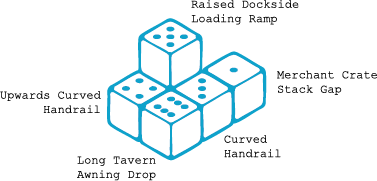
Roll 3d6 +1 for each player and push them together on the table. Each die determines where it can sit and how it's connected to the features around it.
| Die | Feature Type | Note |
|---|---|---|
| 1 | Gap | Touches no more than 1 other area |
| 2 | Grind | Touches no more than 2 areas |
| 3 | Nothing Special | Touches no more than 3 areas |
| 4 | Transition | Can touch up to 4 areas |
| 5 | Elevated Spot | Stack all 5s together, must touch at least 2 areas |
| 6 | Long Line | Merge all 6s in a line, can touch up to 4 areas |
Features are determined by adding adjacent values to the areas's value. For each die, take its own value and add the value of every die touching it in each cardinal direction. Look up the total on the Feature table, that's what's there. City Gate and Noble Ward spots sum all stacked or merged dice into a single value.
A feature can be Gnarly or Technical.
A Gnarly feature costs 1 GNAR to attempt and Slams deal two GNAR per 1.
A Technical feature reduces TECH by 1 for the trick attempt.
| Sum | Feature | Effect |
|---|---|---|
| 3 | Cobblestone Curb | - |
| 4 | Merchant Crate Stack | - |
| 5 | Cracked Flagstone Steps | - |
| 6 | Market Fountain Ledge | Technical |
| 7 | Tavern Benches | - |
| 8 | Marble Manual Slab | - |
| 9 | Broken Cart Kicker | - |
| 10 | Stone Hubba | Technical |
| 11 | Straight Iron Rail | - |
| 12 | Collapsed Manor Archway | - |
| 13 | Tavern Awning Drop | - |
| 14 | Blacksmith Ledges | Technical |
| Sum | Feature | Effect |
|---|---|---|
| 15 | Gutter Gap | - |
| 16 | Ten Stair Set | - |
| 17 | Dockside Loading Ramp | - |
| 18 | Ruined Wall Quarter Pipe | Gnarly |
| 19 | Shipyard Half Pipe | - |
| 20 | Curved Handrail | Technical |
| 21 | Two Storey Roof Drop | Gnarly |
| 22-24 | City Gate Kinked Rail | Gnarly & Technical |
| 25-27 | Temple Stair Flat Stair | Double Gnarly |
| 28-30 | Park Grass Gap | - |
| 31-33 | Noble's Double Kinked Rail | Double Technical |
| 34+ | The Underhold Sewer Walls | - |
Check the highest or lowest neighbouring dice for each feature to add some flavour to them.
If the die is 1, 2, or 3: Sketchy Spot. Check the highest neighbour.
| Die | Condition |
|---|---|
| 2 | Wet, Damp and Stinky |
| 3 | Full of Gravel |
| 4 | Guard Patrol Route; -1 to Vibe roll |
| 5 | Pigeon Shit Everywhere |
| 6 | Cracked and Rough |
If the die is 4, 5, or 6: Hype Spot. Check the lowest neighbour.
| Die | Condition |
|---|---|
| 1 | Secret Line; +1 to Vibe roll |
| 2 | Swept and Tidy |
| 3 | Buttery Smooth Stone |
| 4 | Freshly Waxed |
| 5 | Dwarven Marble; smoothest stone in Orrelia |
Roll for the vibe at the spot:
| d6 | Vibe | Effect |
|---|---|---|
| 1 | Active Guards | Landed tricks also tick the Kickout. |
| 2 | No Trespassing | Bails and Slams tick the Kickout 2. |
| 3 | Folks are watching | Kickout starts at 1. |
| 4-6 | Quiet | Normal Kickout Clock. |
Seeing the Spot as a place. When the dice hit the table you're not looking at a stat block. You're looking at a street corner, a market approach, a ruined ward alley. Read it like a skater would: where's the entry, where's the exit, what's the natural line? A Barrel Kicker next to a Stone Hubba next to a Gutter Gap isn't three separate features, it's a line.
Describe it that way before you roll. Think of the atmosphere of the area. Low sums are tight back alleys with cracked stone and stacked crates. High sums are civic spaces, something was built here with intention.
Describe the place first, then how you're hucking your trick. "There's a long marble ledge running the full length of a shuttered guild hall over a gutter gap along the docks road, I'm going to fakie noseblunt the ledge, heelflip out over the gap."
Both clocks count up to 6 from 0. Track them each with a d6.
Every spot starts with a Kickout Clock of 6. It ticks up from 0 whenever someone bails or slams. When it hits 6, the guards arrive, the locals shut it down, or the wizard locks the gate. This spot is unskateable for the rest of the day.
If you return to a spot on a different day, reset the Kickout clock. If the Clock was 6, the Vibe is now Active Guards. If it was below 6 the Vibe is now No Tresspassing.
The Daylight Clock starts at 0 and does not reset between spots. Tick it up at the end of each full round of skaters. When it hits 6, night has fallen. Reset to 0 and start the next day. You have 3 days.
When arriving at a spot, if a skater has a Lantern they may tick the Kickout Clock up 2 to light it. Lighting a lantern ignores 2 ticks to the Daylight Clock. The longer you linger, the higher chance of being kicked out. A skater can only use their Lantern once per session.
When you land a trick your crew daps you up, high fives you, gives you hugs. Choose one option below. If the trick sequence was 4 or more points choose two instead.
If playing solo, you start each day with 1 Second Wind that you can spend to restore 1 GNAR to yourself.
You can always add a landed trick to your video part if you have a free clip slot. You can only have up to 5 clips in your part. You can swap old clips for new ones by using Kudos for B-Roll.
Clip it: Add the trick to your Video Part. Record the spot, trick and score on your character sheet in an empty clip slot.
Each skater keeps a list of their landed tricks across the session. At the end of play, the group adds up the total points of all their clips. Whoever has the most points gets Last Part. Last Part means you are the raddest, you shred the hardest.
Every spot has a Legend Track from 1 to 6. Roll a d6 and mark the starting Legend when skaters arrive.
Every round, a sick nasty trick can build the spot's notoriety.
Lock it Down: The first 4+ point trick each round ticks the Legend Track +1.
| d6 | Effect |
|---|---|
| 1-2 | Locals are suspicious. Reroll the Vibe. |
| 3-4 | Word is getting around. Kickout Clock starts at 0 as normal. |
| 5 | The spot is known. Folks stop to watch. 1 free TECH on first trick attempt. |
| 6 | Legendary. This spot is part of Orrelia's history. On the first round of tricks, do not tick any clocks. |
If the Legend Track hits 6 while you're there, a Local Legend shows up and challenges the crew.
The first skater calls and attempts a trick on a specific feature. Local Legends always go first. If they land it, the next skater must attempt the exact same trick. If that skater bails or slams, they take a letter (S, K, 8). If you take all three letters in SK8 you're out. Last skater standing wins.
After the game ends tick the Kickout Clock and Daylight Clock twice each.
You can Clip S.K.8. tricks but you don't get Kudos for them.
When a spot's Legend Track hits 6, a Local Legend steps up. Roll a d6 or decide who they are, then immediately start S.K.8.
| d8 | Challenger |
|---|---|
| 1 | A retired Watch Captain who still skates the old ward routes on nights off. FLIP2, GRIND3, TECH2. |
| 2 | An elven city planner who designed half these spots. FLIP 3. |
| 3 | A dwarven stonemason who grinds his own ledges on lunch break. FLIP1, GRIND3, TECH2. |
| 4 | An old orc who skated in the first generation before anyone had a name for it. FLIP 3, GRIND 3, TECH 1. |
| 5 | An apprentice wizard whose board is slightly, illegally, enchanted. FLIP2, GRIND2, TECH4. |
| 6 | A goblin sewer worker who knows lines nobody else has found. FLIP2, GRIND3, TECH 3. |
| 7 | A shipwright who learned on the shipyard halfpipe. FLIP4, GRIND1, TECH2. |
| 8 | Tony Goblioni. Shredlord of Glimmerhold. Only shows up on day 3. If day 1 or 2, mark Tony for Day 3 and roll again. FLIP 3, GRIND 3, TECH 4. |
| d6 | Effect |
|---|---|
| 1 | They know a guard. The next spot's Kickout Clock resets to 0 when it hits 3. |
| 2 | They tip you to a secret line. The next Vibe roll is automatically Quiet. |
| 3 | They cameo in your video. Each skater can add a 6th clip that cannot be swapped. |
| 4 | They tag a spot on your behalf. At the next spot tick the Legend track up one after rolling. |
| 5 | Respect earned. Only tick the Daylight clock once, then roll on this table again. |
| 6 | They show up tomorrow and hype you up. The crew gain permanent +1 TECH tomorrow. |
| d6 | Effect |
|---|---|
| 1 | Word got around. The next Kickout Clock starts at 3. |
| 2 | The crowd remembers. Roll the next Vibe twice and take the lower result. |
| 3 | Bruised ego. Gnarly and Technical features at the next spot cost double to attempt. |
| 4 | They run this district. All spots tomorrow tick down 1 Legend after rolling. |
| 5 | They follow you. The next Local Legend is the same challenger, Hostile, with TECH +1. |
| 6 | Somebody filmed it. Embarrassing. Reduce one of your Clip scores by 3. |
OSRad is effectively a GMless game. The Kickout and Daylight Clocks can be tracked by players and the players can build spots together. The only thing that needs automation is the Local Legend. See below for how to run them.
One player can roll tricks for the Local Legend. They always uses all their TECH rerolls on every attempt if needed. They play to land, every time.
Roll d6 + d8* + d4 simultaneously. Read them in order.
For a Combo, the d4/d8/d20 gives the flip trick then roll the die again for the grind.
- d6 - trick type.
- d8 - specific trick from that list. *(or d4/d20)
- d4 - on a 4, the trick is modified
- odd d6 = switch, even d6 = fakie.
- On 1-3, ignore the d4.
Use Dominant Stat when one stat is higher. Use Equal Stats when FLIP and GRIND are equal.
| d6 | Dominant Stat | d6 | Equal Stats |
|---|---|---|---|
| 1-4 | Higher stat trick | 1-2 | Flip trick |
| 5 | Weaker stat trick | 3-4 | Grind |
| 6 | Combo | 5-6 | Combo |
Applies to whichever stat is being used.
| Stat | d8 Range |
|---|---|
| 1 | d4 (or d8 rolls 1-4 only) |
| 2 | Full d8 |
| 3+ | Advanced d20 |
Only applies when d4 = 4.
| d6 | Modifier |
|---|---|
| Odd | Switch |
| Even | Fakie |
Example: FLIP 1 / GRIND 3, dominant GRIND. Roll d6=3, d20=6, d4=4. Type: dominant (GRIND). Trick: Smith. d4=4 and d6=3 (odd): Switch Smith Grind.
You can roll a d4 using a d8 by treating [1-2] as 1, [3-4] as 2, [5-6] as 3 and [7-8] as 4.
Optional expanded list for experienced crews and high stat Local Legends. Roll d20 to use these with the basic d8 list.
You have 3 days. When a spot's Legend hits 6, the Local Legend appears. The Daylight Clock ticks up every round. When it hits 6 reset and you do it again.
At the end of the run, each skater describes their video part to the table. The skater with the most points gets Last Part. Roll the credits, watch the slams. Head home to ice your knee.
The idea behind building a dice sequence to perform tricks is based on how the pips of each die face look, and each die represents the action of the board.
The pips of a 4 look like the bolts on the top of a skateboard and represent landing your trick clean. The most stable place to land on a skateboard is right on top of the bolts.
With flip tricks, the pips on a 3 are the board making a small rotation while the pips on a 5 are a larger rotation. The pips on a two show the board flipping over, two pips representing two wheels, the pips on a 6 represent the board flipping over the other direction.
With grinds, the pips are a general idea of the contact on the surface. A 6 for a 50-50 because both trucks, effectively the length of the board are on the rail or ledge. A 2 for 5-0 because only one truck, 2 wheels, are in contact. A 3 or a 5 for sliding along the board itself ties back into how 3 and 5 represent board rotation. To achieve a boardslide you have to ollie and rotate onto the rail.
While not all dice combinations line up perfectly with this logic, a little creativity will help you visualize how the dice sequence represents how your board is actually moving.